

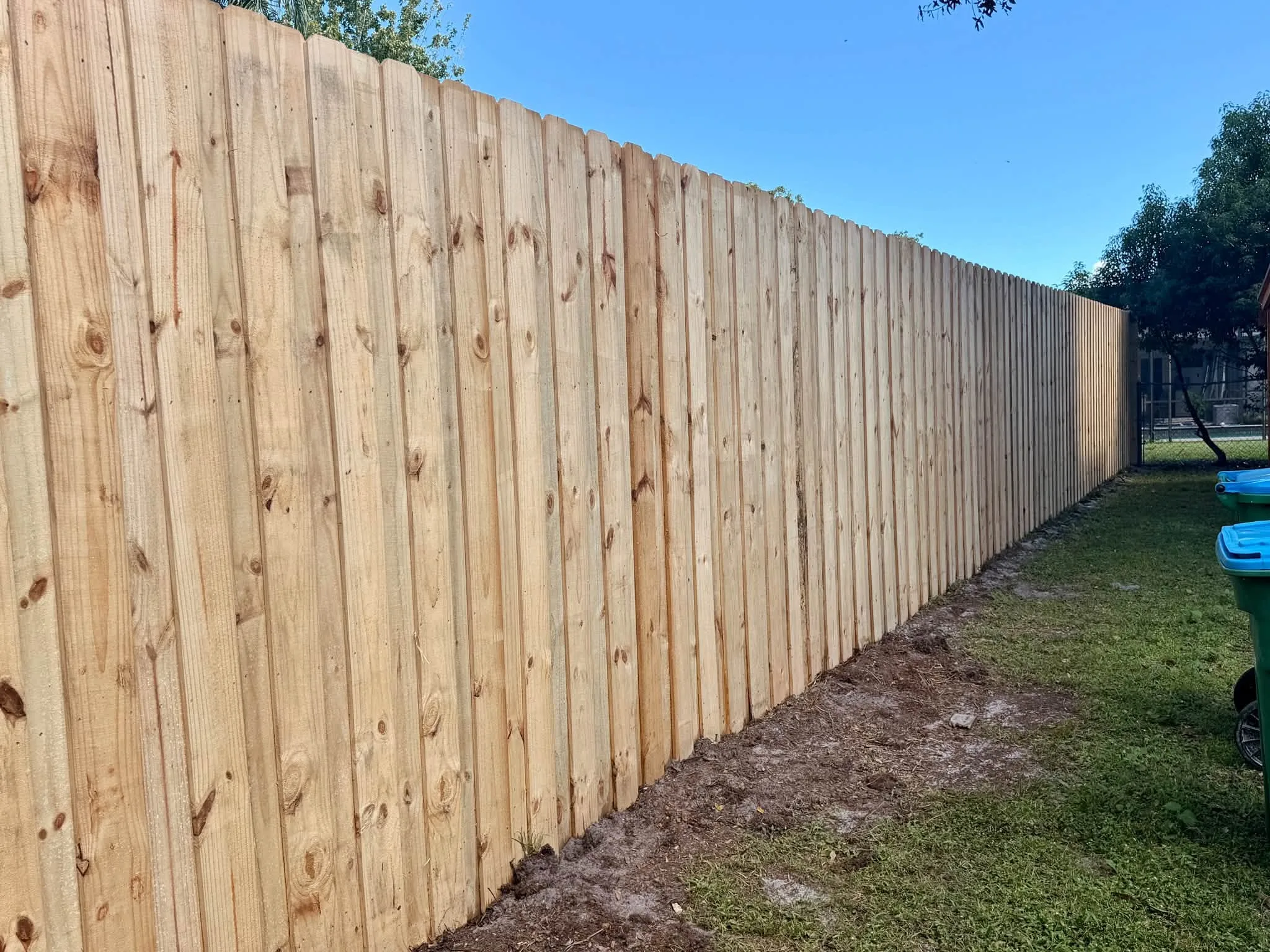
Yes, a wood fence can be a good choice for Florida's humid climate when the right lumber, installation methods, and maintenance practices are used. Wood provides a natural appearance, privacy, and flexibility in fence design, but it requires more ongoing care than some alternative materials.
For Orlando and Central Florida homeowners, heavy rainfall, strong sunlight, termites, and seasonal storms all affect how wood fencing performs over time.
Pressure-treated pine is a practical option because its preservative treatment improves resistance to decay and insects. Naturally durable woods, such as cedar, may also be worth considering depending on availability, grade, and cost.
The decision comes down to whether you prefer the appearance and customization of wood and are comfortable with its maintenance requirements.
Florida's combination of humidity, rainfall, sunlight, and warm temperatures creates conditions that can accelerate wood deterioration.
Wood naturally absorbs and releases moisture. During wet periods, boards may expand. As they dry, they contract. Repeated changes can contribute to:
These problems do not necessarily develop after one rainy season. Their severity depends on the wood, preservative treatment, drainage, installation quality, and maintenance.
Termites are another concern, particularly where untreated or unsuitable wood contacts soil. In coastal areas, salt exposure can also accelerate corrosion of certain fasteners and hardware.
A properly specified wood fence can remain functional for years, but no wood material is immune to Florida's weather.
Pressure-treated pine is a practical starting point for Central Florida homeowners because it is widely available and treated to improve resistance to decay and wood-destroying insects.
City Fence uses pressure-treated lumber for its wood fence installation in Orlando.
Pressure-treated pine offers a balance of availability, cost, and durability when the treatment is appropriate for the intended application.
It is commonly used for fence posts, rails, and pickets, but not every treated board is rated for the same exposure.
Posts installed in soil require lumber rated for ground contact. Above-ground components may have different treatment requirements.
Treatment also does not eliminate normal wood movement, checking, or changes in board spacing as lumber dries.
Western red cedar and redwood heartwood contain naturally occurring compounds that provide some resistance to decay.
However, their durability varies with grade, heartwood content, and exposure. Sapwood generally lacks the same natural resistance.
| Wood Type | Main Advantage | Important Limitation |
| Pressure-treated pine | Widely available and treated to resist decay and insects | Requires the correct treatment rating and regular maintenance |
| Western red cedar | Natural appearance and decay resistance in suitable heartwood | Availability, quality, and cost vary |
| Redwood heartwood | Natural decay resistance in appropriate grades | May be expensive or difficult to source locally |
Neither cedar nor redwood is immune to termites, rot, or weather-related movement.
For most conventional residential wood fences in Central Florida, pressure-treated pine is worth considering first. Other species may be appropriate when a homeowner has specific appearance or material preferences.
Fence posts face prolonged moisture exposure near the ground, while rails and pickets are more affected by repeated wetting and drying. Each component needs suitable materials, installation, and maintenance.
Posts support the rails, pickets, and gates. If a post loses structural strength or shifts in the ground, the surrounding fence may lean or become unstable.
Warning signs include:
Not every leaning fence is caused by rot. Inadequate foundations, disturbed soil, wind exposure, or damaged connections can produce similar symptoms.
The cause should be identified before deciding whether to repair individual components or replace a larger section.
Not necessarily.
Mold or mildew may develop on damp surfaces without indicating structural deterioration. Surface growth can often be cleaned using an appropriate product and method.
Rot involves deterioration of the wood itself. Soft spots, crumbling material, and structural weakness require closer inspection.
Good installation cannot eliminate Florida's weather exposure, but it can reduce avoidable problems.
The most important factors are suitable lumber, post support, drainage, ground clearance, hardware, and gate construction.
Post foundations should be selected according to fence height, material, soil conditions, wind exposure, and applicable local requirements.
Concrete footings may be appropriate where structural support is needed. Gravel may be incorporated into certain foundation designs, but gravel-only installation is not a universal solution for Florida properties.
Posts installed in soil should use appropriately rated ground-contact lumber.
Under American Wood Protection Association guidance, ground-contact applications generally require UC4A or higher treatment, depending on exposure. More demanding conditions may require a higher treatment category, so the specification should match the actual installation environment.
Post dimensions, depth, spacing, and foundation design should be evaluated for the proposed fence rather than assumed from a standard formula.
Pickets and rails that remain in contact with wet soil, mulch, or standing water may deteriorate more quickly.
Appropriate clearance helps reduce prolonged moisture contact and makes inspection easier.
The amount of clearance depends on terrain, fence design, privacy requirements, pets, and site conditions. There is no single measurement suitable for every fence.
Sprinkler placement should also be checked to avoid repeatedly soaking the same fence sections.
Exterior fasteners and hinges should be compatible with pressure-treated lumber and suitable for the property's exposure.
Corrosion-resistant hardware is particularly important near Florida's coast.
When pressure-treated lumber is cut or drilled, exposed areas may require field-applied preservative treatment according to the manufacturer's instructions and applicable standards.
Cut-end preservative treatment is different from decorative staining or sealing. It helps maintain protection where machining exposes untreated wood.
Gate posts, hinges, and latches should also be selected for the expected weight and frequency of use.
No installation method makes a wood fence hurricane-proof. Storm performance depends on the complete fence system, site exposure, and weather conditions.
Wood fences need periodic inspections and maintenance, particularly in Florida's wet and sunny conditions.
Checking the fence once or twice a year, and after significant storms, can help identify problems before they become more serious.
A practical maintenance routine includes:
There is no universal staining or sealing schedule.
The appropriate interval depends on the wood, finishing product, sunlight, rainfall, and condition of the existing coating.
Some finishes may need renewal after a few years. Others have different maintenance requirements.
New pressure-treated lumber may also need time to dry before accepting certain coatings. The timing depends on moisture content, weather, and the product being applied.
Follow the finish manufacturer's preparation and moisture recommendations rather than applying a coating according to a fixed calendar schedule.
Regular maintenance can help limit deterioration, but it does not guarantee a specific fence lifespan.
Both wood and vinyl fencing can work well in Central Florida, but they suit different homeowner priorities.
Wood offers a natural appearance, customizable styles, and the ability to repair individual boards in many designs.
Vinyl generally requires less routine surface maintenance because it does not rot like wood and is not a food source for wood-destroying insects.
However, vinyl is not maintenance-free. It can still experience impact damage, thermal movement, discoloration, or gate alignment problems.
Both solid wood and vinyl privacy fences also require appropriate post support because they create significant wind exposure.
| Consideration | Wood Fencing | Vinyl Fencing |
| Appearance | Natural grain with stain and paint options | Consistent manufactured colors and styles |
| Moisture | Requires suitable treatment and upkeep | Does not rot or absorb moisture like wood |
| Maintenance | Periodic repairs, cleaning, and finish renewal | Cleaning and hardware inspections |
| Repairs | Individual boards can often be replaced | Panels or components may need replacement |
| Cost | Depends on lumber, style, and installation | Depends on product grade, style, and installation |
| Weather concerns | Decay, movement, insects, and finish wear | Wind loading, impact damage, and thermal movement |
Yes. If minimizing staining and routine wood repairs is a priority, vinyl may be the better fit.
City Fence offers both materials, and homeowners can review its vinyl fencing guide for Orlando when comparing options.
Vinyl may have a higher upfront quote for some designs, but that is not universal. Long-term costs depend on installation quality, maintenance, repairs, and the products being compared.
Neither material should be presented as guaranteed to outlast the other in every situation.
Wood fencing is a practical choice for Central Florida homeowners who value a natural appearance, design flexibility, and the option to replace individual boards.
Before deciding, consider the property's drainage, irrigation exposure, wind conditions, maintenance needs, and the type of lumber and post support being proposed.
Pressure-treated wood can perform well when the material specifications and installation suit the site, but it will still require periodic care.
If reducing routine maintenance is your main priority, vinyl is worth comparing. If you prefer natural wood and are prepared for its upkeep, a properly installed wood fence remains a reasonable option for Florida's humid climate.
Orlando and Central Florida homeowners can contact City Fence to compare wood and vinyl fencing, discuss drainage and installation conditions, and determine which material fits their backyard and maintenance preferences.