

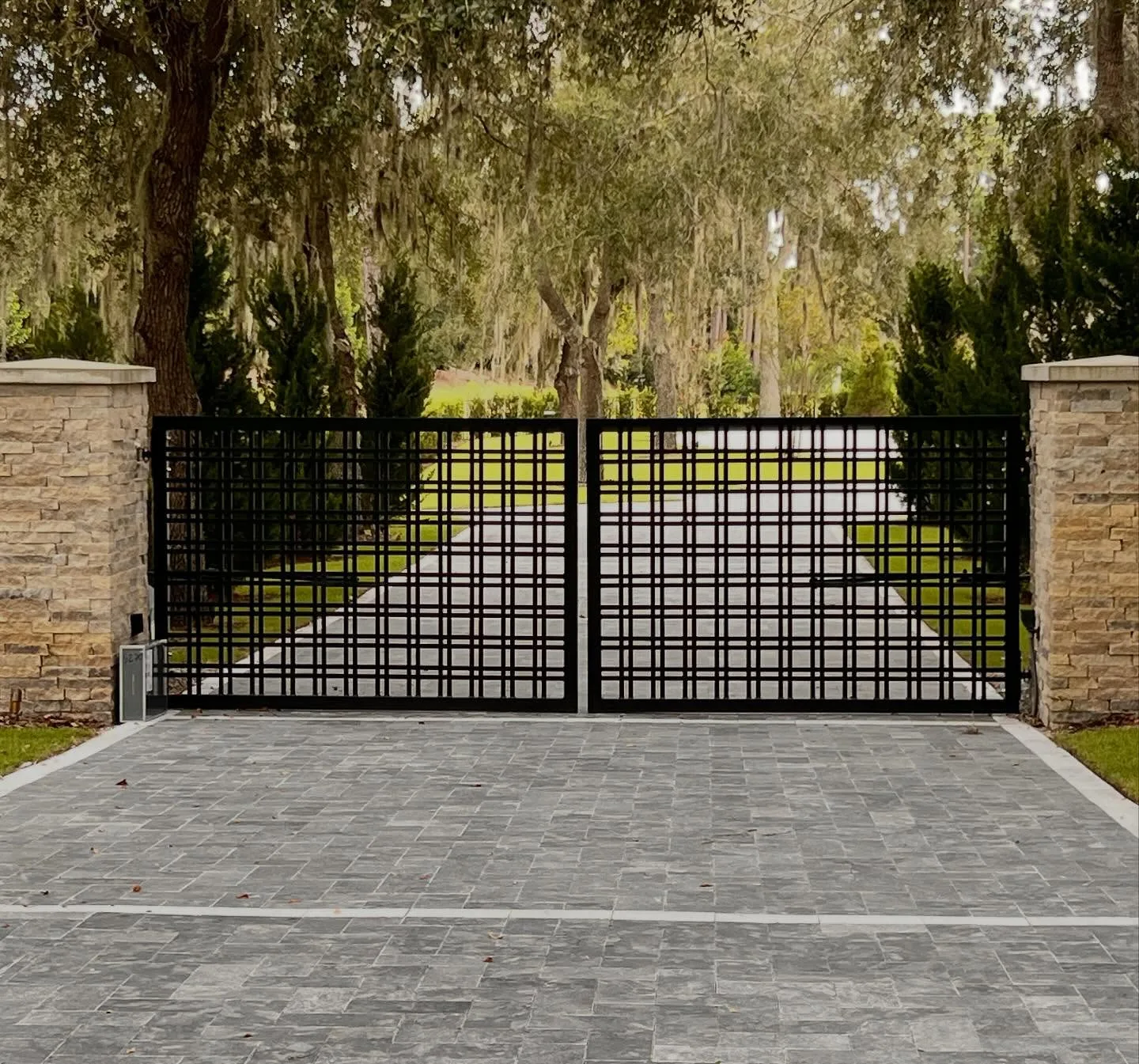
There is no single driveway gate that is best for every residential property. For Winter Garden and Greater Orlando homeowners, the right choice depends on driveway layout, available clearance, security needs, architectural style, automation preferences, and budget.
Choosing the right gate usually comes down to three decisions: how the gate moves, what material it is made from, and how you want to control access.
Driveway layout and available operating space should guide the choice between swing and sliding configurations. Material selection should reflect appearance, privacy, structural needs, and Central Florida's humid climate.
Aluminum is a popular residential option because it offers design flexibility and strong resistance to rust. Gate width, vehicle approach, automation, and access control should all be considered during the initial design rather than added later.
Start with the property rather than a particular gate style. Driveway dimensions, grade, vehicle movement, available operating space, and the home's architecture can quickly narrow the practical options.
When choosing a residential driveway gate, consider how wide the driveway is, how vehicles approach and turn into it, and whether there is enough room for the gate to operate without interfering with landscaping, structures, or parked vehicles. Privacy goals, architectural style, automation needs, budget, and HOA or community requirements can then help narrow the choices further.
Evaluating these factors first helps prevent choosing an attractive design that does not function well on the property.
The primary difference is the space each configuration needs to operate. Swing gates require an unobstructed opening arc, while sliding gates require sufficient room alongside the driveway for horizontal travel.
| Feature | Swing Gate | Sliding Gate |
| Movement | Opens inward or outward | Moves horizontally beside driveway |
| Space needed | Clear swing area | Clear space beside opening |
| Sloped driveway considerations | Grade can affect opening clearance | Grade and slide path must be evaluated |
| Appearance | Often traditional or formal | Often clean and streamlined |
| Automation | Available | Available |
| Key planning factor | Swing radius | Lateral travel space |
Swing configurations are practical when the entrance provides enough unobstructed room for the gate leaves to open. The driveway grade must also allow sufficient clearance throughout the opening arc.
A single-swing design uses one larger leaf, while a double-swing design divides the opening between two leaves. Property dimensions, gate weight, and desired appearance help determine which configuration is appropriate.
Sliding configurations can solve layouts where an opening arc would interfere with vehicles, landscaping, structures, or other features.
They still require adequate usable space alongside the entrance. That area must be evaluated for distance, grade, and other site conditions before a sliding configuration is selected.
Material selection should balance appearance, privacy, structural requirements, and environmental exposure. Aluminum, steel, and wood each serve different priorities rather than competing for one universal “best” position.
| Material | Key Advantages | Main Considerations | Often Suited For |
| Aluminum | Rust-resistant, versatile appearance, automation-friendly | Lighter visual character than some alternatives | Ornamental and contemporary entrances |
| Steel | Substantial appearance and broad design flexibility | Protective finish is important for corrosion exposure | Heavier ornamental designs |
| Wood | Warm appearance and greater visual privacy | Weight and weather exposure influence design | Privacy-focused and traditional properties |
Aluminum is often well suited to Central Florida because it does not contain iron and therefore does not develop the same type of rust associated with steel. It also accommodates a wide range of ornamental and architectural designs.
Finish quality, fabrication, hardware, and installation still matter in Florida's humidity, frequent rainfall, and strong sunlight. Aluminum should therefore be viewed as corrosion-resistant rather than unaffected by outdoor exposure.
The opening should provide comfortable clearance for the vehicles that regularly use the driveway. Vehicle dimensions alone are not enough because approach angle and turning room can substantially affect the space required.
As a general planning reference, many residential vehicle entrances provide approximately 10 to 12 feet of clear opening for ordinary passenger-vehicle access. This is not a universal standard, and properties accommodating pickups, trailers, angled approaches, or larger service vehicles may require additional room.
When determining the opening, consider vehicle width and mirrors, approach angle, turning radius, gate posts, and hardware. Homeowners should also account for occasional trailer, delivery, or service-vehicle access and any applicable community or access requirements.
The usable clear opening matters more than the nominal dimensions of the gate itself.
Automation is most useful when homeowners expect to open and close the entrance frequently. It allows controlled vehicle access without requiring someone to manually operate the gate during every arrival and departure.
Daily use is one of the biggest considerations. The number of household users, frequency of visitors, distance between the entrance and home, desired access control, and plans for backup operation during outages can all influence the appropriate system.
A less frequently used entrance may not require the same level of automation as a primary driveway used several times each day.
Outage operation depends on the operator and access-control equipment selected for the project. Depending on the system, battery backup, standby power, or manual-release provisions may be available.
The entire access system should be considered during planning because the gate operator, keypad, intercom, and other components may have different power requirements.
Access control should match the people who regularly enter the property. A household-only entrance may have different requirements from a property that frequently receives guests, contractors, or deliveries.
Remote transmitters and keypads can provide straightforward household access, while mobile credentials, vehicle-based credentials, intercoms, and visitor-access systems can provide additional flexibility when more people need controlled entry.
The goal is to provide convenient access for authorized users without making everyday entry unnecessarily complicated.
Slope affects operating clearance and should be evaluated before the configuration is finalized. Even a design that works well on level ground can encounter problems when the driveway rises, falls, or changes grade near the entrance.
For swinging configurations, the opening arc must have enough clearance above the driveway throughout its movement. For sliding configurations, the area alongside the entrance needs an appropriate travel path.
The entire entrance grade should therefore be evaluated instead of choosing a configuration based solely on the fact that the driveway is sloped.
Cost depends on the design, material, dimensions, site conditions, and level of automation or access control. Custom fabrication, larger openings, complicated sites, and additional technology can increase the overall investment.
Gate width and height, material, swing or sliding configuration, ornamental details, operator equipment, and access controls all affect pricing. Electrical requirements, site preparation, driveway grade, structural posts, and installation complexity can also change the final project cost.
An accurate estimate should be based on the actual entrance rather than a generic gate-panel price.
One of the biggest mistakes is selecting appearance before confirming how the entrance needs to function. A design can look ideal but become inconvenient if there is insufficient clearance, an awkward vehicle approach, or automation requirements that were not considered early enough.
Other common problems include choosing an opening that is too restrictive, overlooking driveway grade, failing to account for trucks or trailers, and adding automation late in the design process. Homeowners should also consider backup access during power outages and review applicable HOA or community requirements before finalizing the project.
A gate contractor should evaluate the complete entrance and explain how the proposed design addresses the property's specific conditions. Before moving forward, homeowners should ask:
Clear answers to these questions can help homeowners understand both the proposed gate and the complete scope of installation before committing to the project.
The right driveway gate should fit the property's dimensions, vehicle traffic, architectural style, privacy goals, and daily access needs. Starting with those requirements makes it easier to determine the appropriate configuration, material, dimensions, and automation system without relying on a one-size-fits-all recommendation.
City Fence brings more than 20 years of experience designing and installing residential gates throughout Winter Garden, Orlando, and Central Florida. Homeowners can request a personalized estimate based on their property's layout and access requirements, with workmanship warranty protection and financing options available for qualifying projects.
Ready to plan your driveway gate? Schedule a consultation with City Fence to discuss your property, access needs, and design goals, and receive a personalized estimate for your project.