

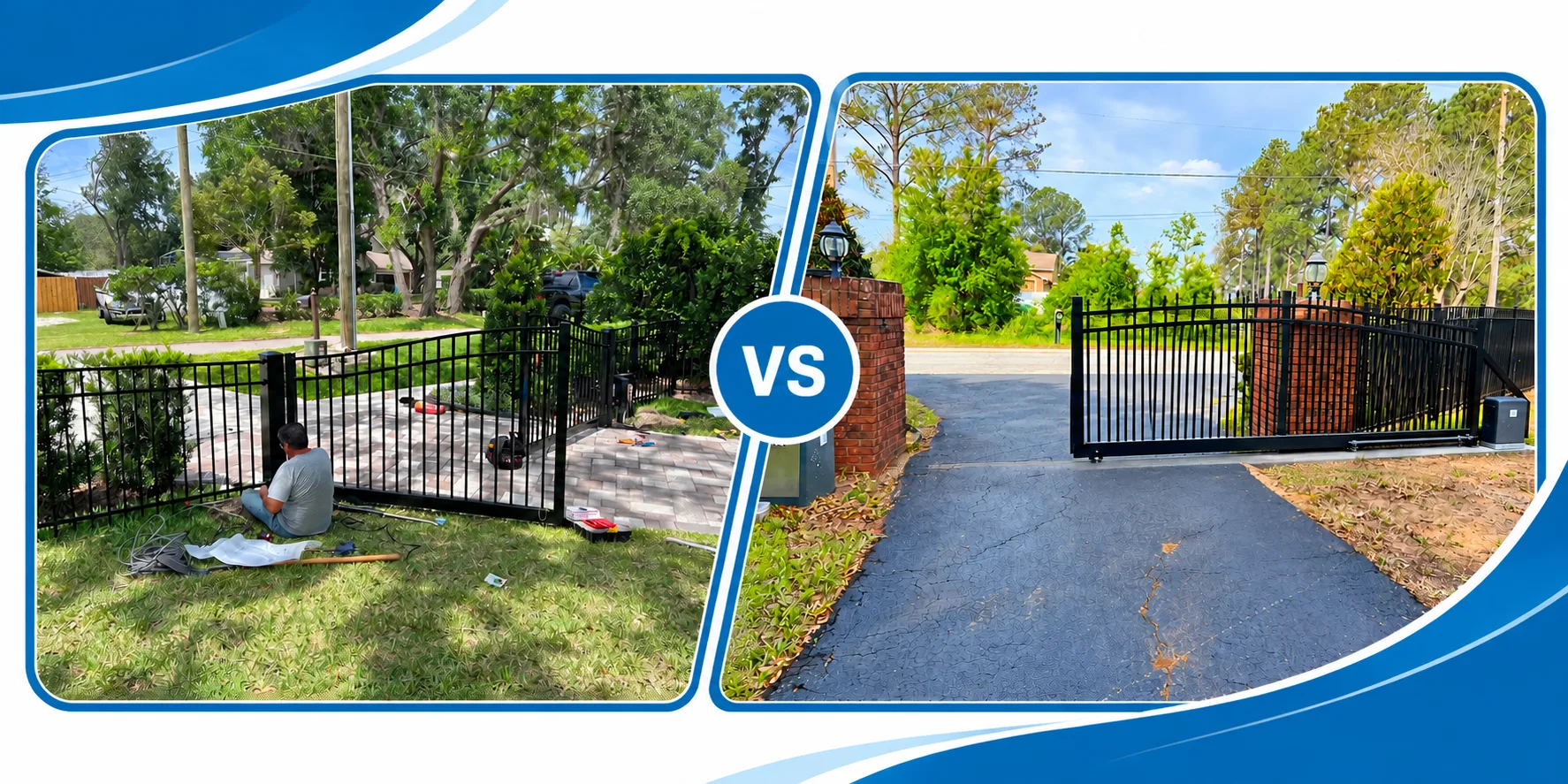
Swing gates and sliding gates can both work for Central Florida homes and managed properties, but they fit different site conditions. The right choice depends on driveway layout, available space, slope, gate size, vehicle movement, operator needs, and access-control requirements.
A swing gate opens on hinges and needs a clear arc to move. A sliding gate moves sideways along the entrance or fence line and needs enough side room for the gate to travel. Neither option is automatically better for every property.
A simple way to compare them is:
available space + driveway grade + gate size + vehicle access + operator needs = the right gate style
For Orlando and Central Florida homeowners, the best gate choice should be based on how the entrance actually works day to day.
A swing gate opens inward or outward on hinges. It moves in an arc, similar to a large door. Homeowners planning driveway gate installation should consider available space, driveway grade, vehicle movement, and gate clearance before choosing a style.
A sliding gate moves horizontally along the entrance area. Depending on the design, it may use a track, rollers, guides, or a cantilever system. Sliding gates are often considered when there is not enough room for a swing gate to open, but they still need enough side-storage space and a suitable travel path.
The main difference is movement. Swing gates need clear swing space. Sliding gates need clear side space.
A swing gate may be a good fit when the property has enough open space for the gate to move through its full arc.
Swing gates are often considered for:
Swing gates can be single or double. A single swing gate uses one larger gate leaf, while a double swing gate uses two smaller leaves that meet near the center. A double swing gate may reduce the amount of clear space needed behind each leaf, but it also requires proper center alignment, two gate leaves, and coordinated hardware or operators.
A swing gate should not be forced into a layout where vehicles, slopes, sidewalks, roads, or property lines create conflicts.
A sliding gate may be a better option when the entrance does not have enough clear space for a swing gate to open safely.
Sliding gates are often considered for:
A sliding gate still needs planning. The gate must have enough room to slide fully open along the fence line or side-storage area. The ground, drainage, grade, operator location, and nearby obstructions all affect whether a sliding gate is practical.
A sliding gate may solve a swing-clearance problem, but it is not automatically the answer for every tight or sloped property.
A swing gate needs enough clear space for the full gate arc. The required clearance depends on the opening width, gate configuration, hinge location, swing direction, grade, and nearby obstructions.
A single wide gate generally needs more open swing area than two shorter gate leaves. A double gate can reduce the depth of the swing arc on each side, but it still needs enough space for both leaves to open and close properly.
The gate layout should account for:
An outward swing may appear to solve a driveway-space problem, but it is not always acceptable. A gate should not swing into a road, sidewalk, public right-of-way, or area where it creates a safety or access conflict.
A sliding gate needs enough side room for the gate to move completely out of the opening. That side-storage area is just as important as the driveway opening itself.
For some sliding gates, the side area must be at least as long as the gate opening. Cantilever-style gates may need additional space because part of the gate extends beyond the opening for support.
The side-storage area should be reviewed for:
A sliding gate cannot work properly if the gate has nowhere to travel.
Slope affects swing gates and sliding gates in different ways.
A swing gate can run into problems if the driveway rises through the gate’s swing path. The bottom of the gate may have enough clearance when closed but scrape the driveway as it opens. Gate width, hinge location, swing direction, and grade all matter.
A sliding gate may be helpful when a swing gate would lose clearance on a slope. However, the sliding path also needs to be suitable. If the ground beside the entrance is steep, uneven, soft, wet, or blocked, a sliding gate may create its own problems.
The best choice depends on where the slope occurs:
| Site Condition | Swing Gate Consideration | Sliding Gate Consideration |
| Level driveway with open space | Often practical | May still work, but side room is needed |
| Driveway rises into swing path | May scrape or lose clearance | May be worth considering |
| Limited space behind gate | May be difficult | Often more practical if side room exists |
| Steep or uneven side-storage area | May avoid side-travel issues | May be difficult without grading or redesign |
| High-use entrance | Must allow safe vehicle waiting space | May support controlled access if designed properly |
A site review should look at the full gate movement path, not just the driveway opening.
An automatic gate operator must match the actual gate and site conditions. The operator should be selected based on gate weight, gate length, opening style, duty cycle, wind exposure, hinge or track design, and how often the gate will be used.
The operator cannot fix a gate that is poorly sized, poorly supported, or physically unable to move through its intended path.
Automatic gate planning should include:
Any required line-voltage electrical work should be handled by a qualified electrical professional where required.
A residential driveway gate used only a few times per day has different operator needs than a gate used frequently by residents, vendors, property staff, or service vehicles.
Both gate styles can work well when they are matched to the property.
| Factor | Swing Gate | Sliding Gate |
| Movement | Opens inward or outward on hinges | Moves sideways along the entrance or fence line |
| Space needed | Clear swing arc | Clear side-storage area |
| Slope concerns | Can be difficult if grade rises through the swing path | May work better in some sloped layouts, but side grade still matters |
| Appearance | Traditional driveway-gate look | Clean, space-saving entrance style |
| Gate operator | Must match gate size, weight, wind exposure, and use | Must match gate weight, travel path, guide system, and use |
| Maintenance focus | Hinges, posts, alignment, operator arms | Track or guide path, rollers, debris, operator system |
| Best fit | Properties with enough open swing space | Properties with limited swing clearance and enough side room |
The better gate is the one that fits the entrance, not the one that sounds better in general. Homeowners still comparing materials, layouts, and entrance styles can also review how to choose the best driveway gate for a residential property.
Swing gates and sliding gates can both work with access-control features when the system is planned correctly.
Common options may include:
Access control should be planned around who uses the entrance. A single-family driveway may only need simple remote or keypad access. A managed property may need resident access, vendor access, delivery access, emergency access, and after-hours procedures.
The access-control plan should be selected with the gate operator, power source, safety devices, and daily traffic pattern in mind.
Before choosing a swing or sliding gate, the entrance should be reviewed as a complete system.
Important conditions include:
Central Florida properties may also need extra attention to drainage, soft ground, storm debris, wind exposure, and site access around landscaping or tight side yards.
A driveway gate should be planned around how the property is actually used, not just how the gate looks from the street.
Swing gates can work well where there is enough clear space for the gate to open safely. Sliding gates may be a better fit where swing clearance is limited, but they still need enough side room and a suitable travel path.
Both gate styles require proper posts, hardware, operator sizing, safety devices, power planning, access control, and emergency access. The right choice depends on the driveway layout, slope, vehicle movement, and daily use of the property.
Orlando and Central Florida homeowners and property managers can contact City Fence to review driveway layout, gate style, access needs, operator planning, and site conditions before choosing a swing or sliding gate.
